
TABLE 4
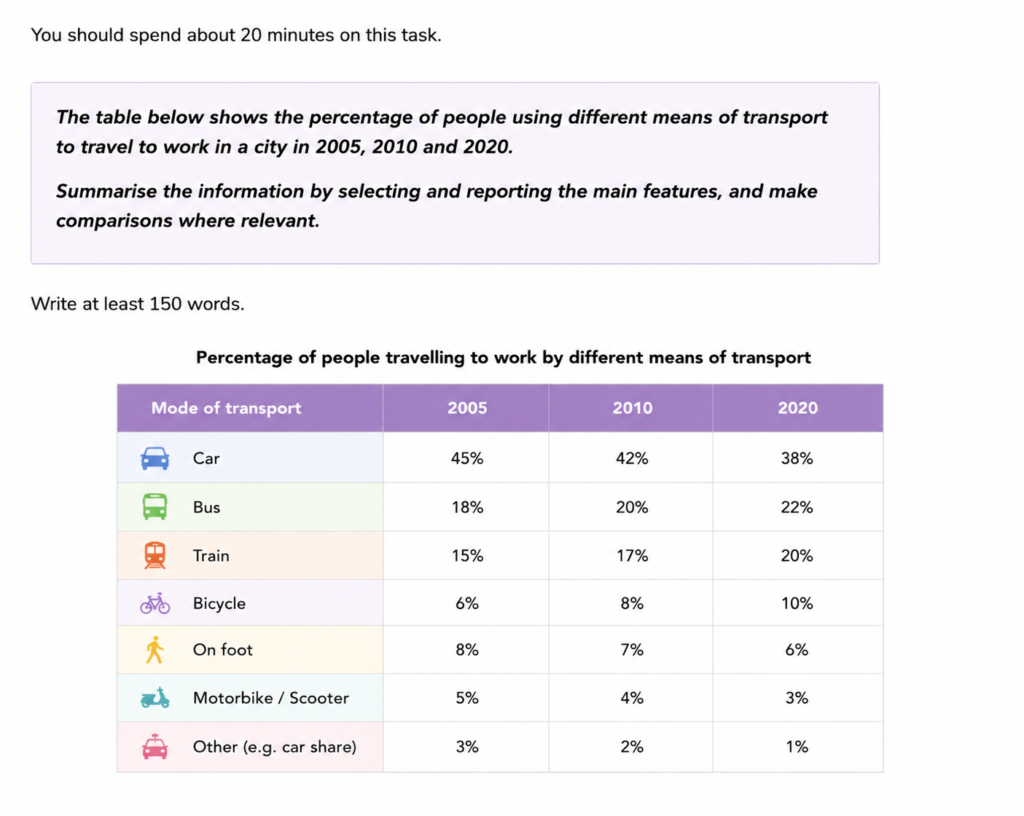
The table compares the percentages of people who used seven different means of transport to travel to work in a particular city in 2005, 2010 and 2020.
Overall, cars remained by far the most popular means of transport throughout the period, despite a noticeable decline in their use. By contrast, the proportions of people travelling by bus, train and bicycle increased, while walking, motorbike or scooter use, and other forms of transport became less common.
In 2005, 45% of people travelled to work by car, considerably more than the figures for buses and trains, at 18% and 15% respectively. However, the proportion of car users fell steadily to 42% in 2010 and then to 38% in 2020. Meanwhile, bus use rose gradually from 18% to 22%, while the percentage of train passengers increased from 15% to 20%. Bicycle use also experienced growth, rising from just 6% in 2005 to 10% by the end of the period.
The remaining modes of transport all became less popular. The proportion of people travelling on foot decreased slightly from 8% in 2005 to 6% in 2020. Similarly, motorbike and scooter use fell from 5% to 3%. Other forms of transport accounted for the smallest proportion throughout the period, declining from 3% to just 1%.
Vocabulary to highlight
- means of transport — ways of travelling
- by far the most popular — much more popular than all the others
- throughout the period — during the entire period
- despite a noticeable decline — although there was a clear decrease
- the proportions of people — useful alternative to repeatedly using percentages
- became less common — decreased in popularity/use
- considerably more than — much more than
- respectively — in the same order as the figures previously mentioned
- fell steadily — decreased consistently
- meanwhile — introduces another trend happening during the same period
- rose gradually — increased slowly
- experienced growth — increased
- by the end of the period — by the final year shown
- decreased slightly — fell by a small amount
- accounted for the smallest proportion — represented the lowest percentage