
You should spend about 20 minutes on this task.
The diagram below shows how milk is processed to produce yogurt and cheese. Summarise the information by selecting and reporting the main features, and make comparisons where relevant.
Write at least 150 words.
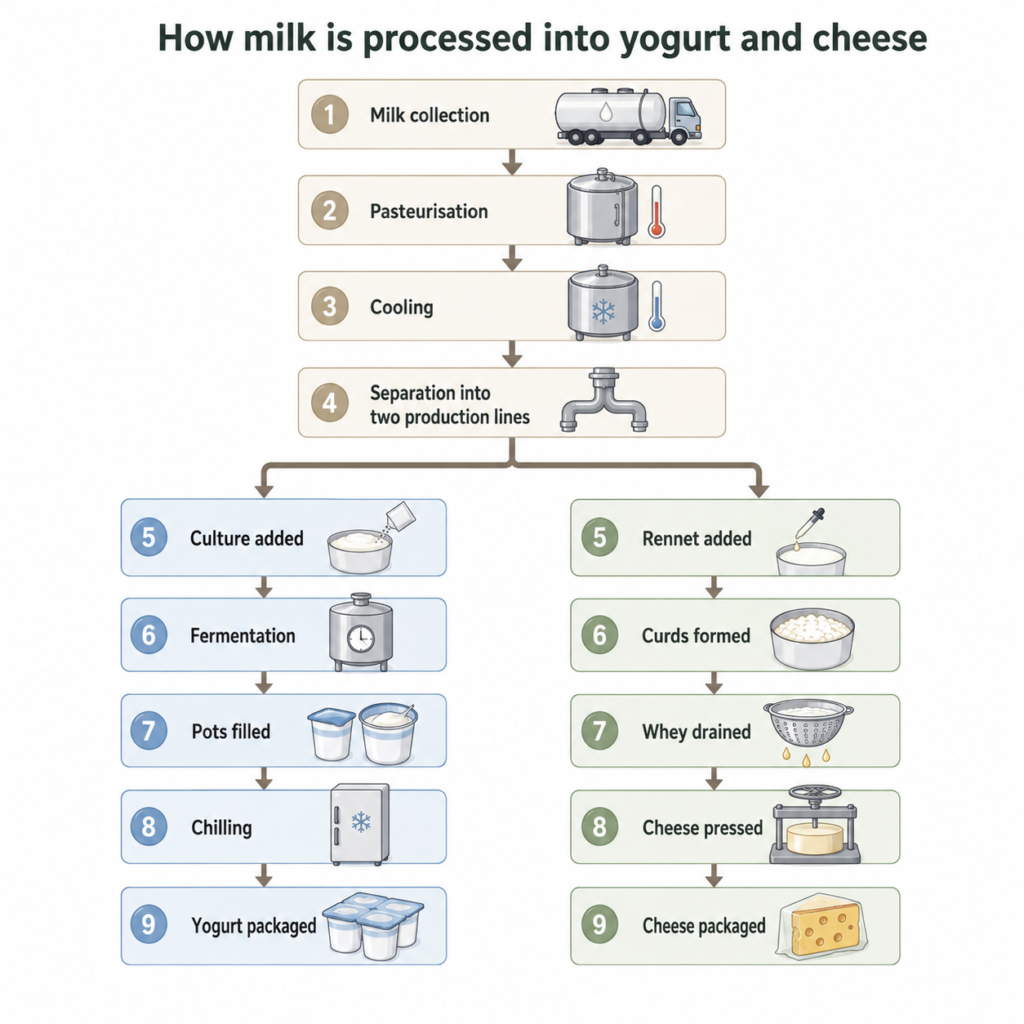
The diagram illustrates the process by which milk is processed into two different dairy products: yogurt and cheese.
Overall, the production process begins in the same way for both products, with milk being collected, pasteurised and cooled. After this, the process divides into two separate production lines. Yogurt is made through fermentation before being chilled and packaged, whereas cheese production involves the formation of curds, the removal of whey and pressing before packaging.
Initially, fresh milk is collected and transported for pasteurisation, after which it is cooled. The milk is then separated into two production lines. In the yogurt-making process, a bacterial culture is added to the milk, and the mixture is left to ferment. Once fermentation is complete, the yogurt is poured into individual pots, chilled and finally packaged for sale.
The cheese-making process follows a different sequence. Rennet is first added to the milk, causing curds to form. The whey is then drained off, leaving the solid curds behind. These are subsequently pressed into shape before the finished cheese is packaged. Thus, while the two products share the same initial preparation stages, they undergo distinct forms of processing after the milk is divided.
Vocabulary to highlight
- is processed into — is changed into another product
- begins in the same way — starts with identical stages
- divides into two separate production lines — splits into two different processes
- whereas — used to contrast two processes
- is collected and transported — useful passive structure
- is pasteurised — is heated to make it safe
- is cooled — its temperature is reduced
- is separated into — is divided into different streams
- a bacterial culture is added — a culture is introduced to the milk
- is left to ferment — is allowed to undergo fermentation
- once fermentation is complete — after the fermentation stage has finished
- is poured into individual pots — is transferred into containers
- rennet is added — an enzyme is introduced to the milk
- curds are formed — solid parts develop in the milk
- the whey is drained off — the liquid is removed
- subsequently pressed into shape — compressed afterwards
- the finished cheese is packaged — the final product is prepared for sale
- share the same initial stages — have identical first steps
- undergo distinct forms of processing — experience different later stages