
TABLE 5
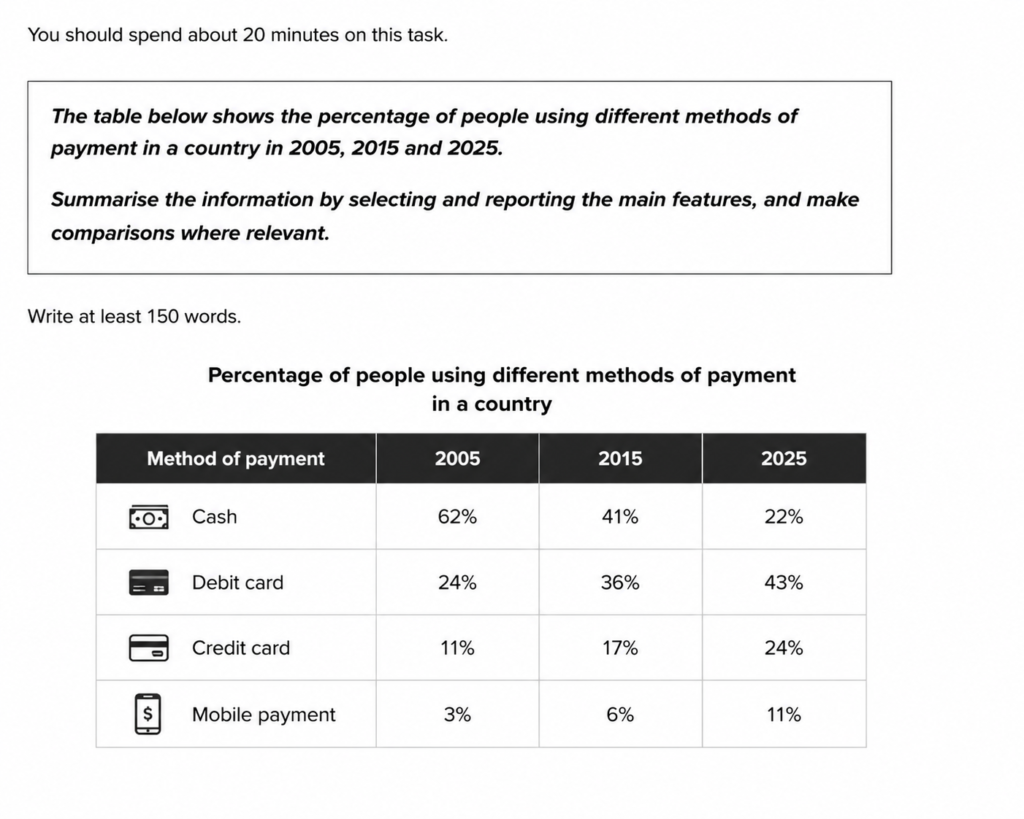
The table compares the percentages of people who used four different payment methods in a particular country in 2005, 2015 and 2025.
Overall, there was a clear shift away from cash towards card and mobile payments over the period shown. While cash was by far the most widely used payment method in 2005, its popularity declined considerably, whereas all three cashless methods became more common. By 2025, debit cards had become the most popular form of payment.
In 2005, almost two-thirds of people paid in cash, at 62%, compared with just 24% who used debit cards. However, the proportion of cash users fell sharply to 41% in 2015 and then to only 22% in 2025. By contrast, debit card use increased steadily, rising from 24% to 36% and eventually reaching 43%. As a result, debit cards overtook cash to become the leading payment method by the end of the period.
Credit cards and mobile payments also experienced considerable growth. The percentage of credit card users more than doubled, from 11% in 2005 to 24% in 2025, meaning that it also surpassed cash in the final year. Meanwhile, mobile payments remained the least common method throughout the period, despite rising from just 3% to 11%.
Vocabulary to highlight
- a clear shift away from X towards Y — a change from one thing to another
- over the period shown — during the period presented
- by far the most widely used — much more commonly used than the others
- declined considerably — decreased significantly
- cashless methods — ways of paying without physical cash
- became more common — increased in popularity
- almost two-thirds of — approximately 66%
- compared with — useful for directly comparing figures
- fell sharply — decreased significantly
- by contrast — introduces an opposite trend
- increased steadily — rose consistently
- overtook — became higher or more popular than another category
- the leading payment method — the most commonly used method
- more than doubled — increased to more than twice the original figure
- surpassed — became higher than
- remained the least common — continued to have the lowest figure
- despite rising from … to … — useful for contrasting a low ranking with an increase